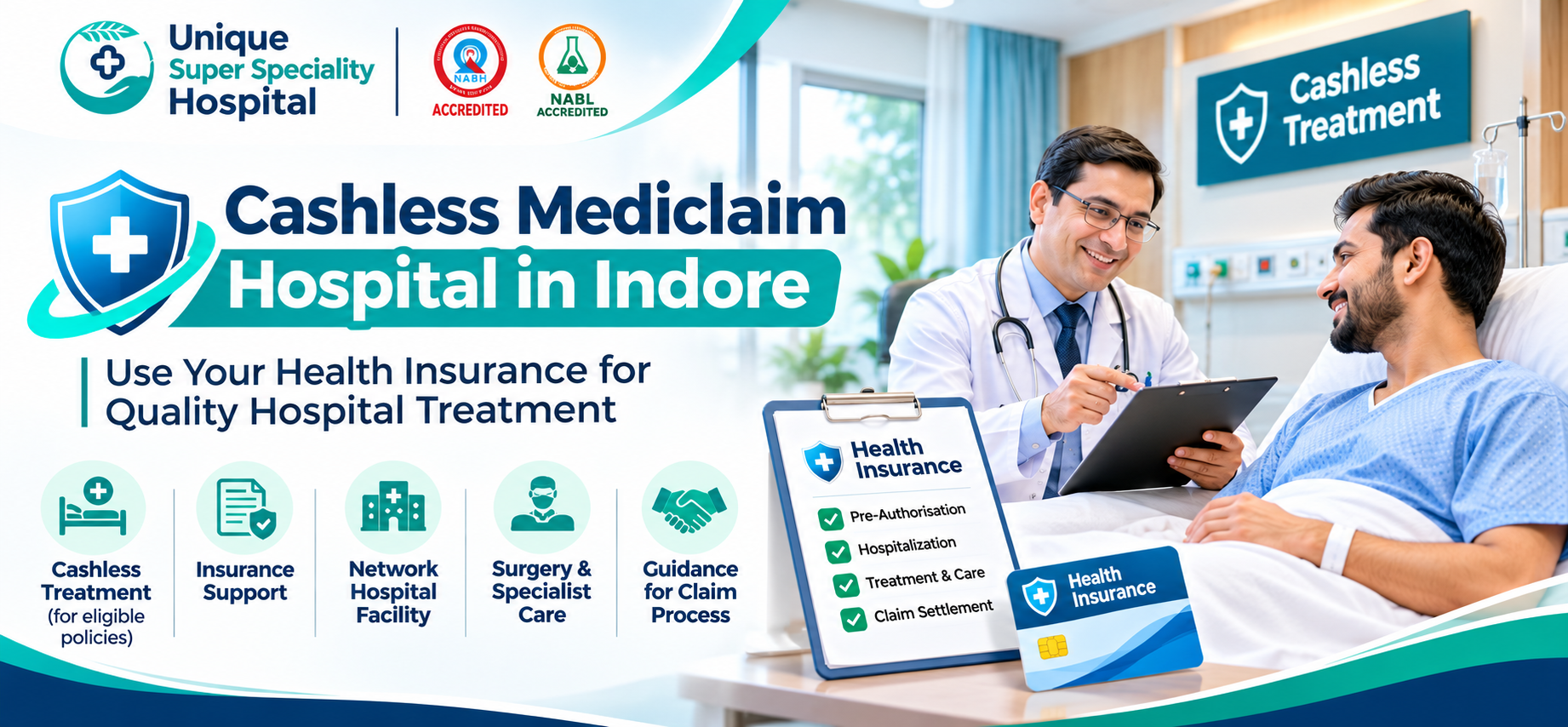
Medical treatment and hospitalization can involve significant expenses, particularly when a patient requires surgery, intensive care, diagnostic investigations or prolonged treatment. Health insurance can help eligible policyholders manage covered medical expenses according to the terms and conditions of their policy.
For patients searching for a Cashless Mediclaim Hospital in Indore, understanding how cashless hospitalization works can make the admission and insurance process easier to navigate.
Unique Super Speciality Hospital, Indore provides cashless mediclaim and health insurance-related support for eligible patients. Cashless approval, coverage, deductions and claim settlement depend on the patient's insurance policy, insurer, Third Party Administrator (TPA), treatment and applicable terms.
What Is Cashless Hospitalization?
Cashless hospitalization is a health insurance facility in which an eligible insured patient may receive covered treatment at a network hospital without paying the entire eligible hospital bill upfront. The hospital and insurer or TPA coordinate the authorization and claim process.
Cashless does not necessarily mean that every hospital expense is completely free. Depending on the policy, the patient may still need to pay:
- Deductibles
- Co-payments
- Non-covered expenses and policy exclusions
- Expenses above applicable limits or sub-limits
- Other charges not approved by the insurer
Always confirm policy coverage and possible out-of-pocket expenses before planned hospitalization.
How Does Cashless Mediclaim Work?
The process can vary between insurers and policies, but a typical cashless hospitalization process may include the following steps.
Step 1: Check Your Health Insurance Policy
Before planned treatment, check your insurance company, policy validity, sum insured, network-hospital eligibility, coverage for the proposed treatment, waiting periods, co-payment conditions, room-rent limits, exclusions and sub-limits. Contact your insurer or TPA if you need clarification.
Step 2: Confirm Hospital and Insurance Details
If you are planning treatment at a cashless hospital in Indore, contact the hospital's insurance or billing desk before admission. Share your insurance details and ask whether your specific policy can be processed for cashless hospitalization for the proposed treatment. Hospital and insurer networks can change, so confirmation before admission is recommended.
Step 3: Submit the Required Documents
The hospital may request your health insurance card or policy details, government-issued identity proof, doctor's consultation or prescription, previous medical records, diagnostic reports, admission advice where applicable, and patient and policyholder details. Additional documents may be requested depending on the insurer, TPA and treatment.
Step 4: Pre-authorisation
For planned cashless hospitalization, the hospital may submit a pre-authorisation request to the insurer or TPA. The request generally contains patient details, diagnosis, proposed treatment, estimated expenses, hospital details and relevant medical documents.
Step 5: Approval or Query
The insurer or TPA may approve the request, approve it partially, ask for additional information, raise a query or decline authorization according to the policy terms. Approval does not automatically mean that every expense will be covered.
Step 6: Treatment and Hospitalization
Once authorization is received, treatment can proceed as advised by the treating doctor. If additional investigations or procedures become necessary during hospitalization, further authorization may be required depending on the insurer and policy.
Step 7: Discharge and Final Claim Processing
At discharge, the hospital prepares the final bill and relevant medical documents. The insurer or TPA processes the eligible amount according to the policy. Any non-payable or patient-responsibility amount may need to be paid by the patient.
What Documents Are Usually Required for Cashless Treatment?
Requirements differ between insurers and TPAs, but keeping commonly requested documents ready can help.
Basic Documents
- Health insurance card
- Policy number and policyholder details
- Patient's identity proof
- Contact number
- Doctor's prescription or consultation documents
Medical Documents
- Diagnostic and blood-test reports
- X-rays
- CT scans, ultrasound or MRI reports, where applicable
- Previous treatment and hospital records
- Documents supporting the proposed surgery, if applicable
The hospital, insurer or TPA may request additional documents for a particular claim.
Can You Get Cashless Treatment for Surgery?
Cashless hospitalization may be available for eligible and covered surgical procedures when the hospital, insurer or TPA, and the patient's policy meet applicable requirements. Examples may include certain orthopedic surgeries, joint replacement procedures, spine procedures, laparoscopic surgeries, cardiac procedures and other medically necessary treatments.
Coverage depends on the individual policy. For example, a patient considering robotic knee or hip replacement should confirm whether the proposed procedure, hospitalization, implants, room category and associated expenses are covered.
Contact the hospital about treatment and appointment enquiries, and confirm insurance coverage with your insurer or TPA.
Cashless Mediclaim for Orthopedic Treatment
Orthopedic treatment can involve consultation, diagnostic investigations, hospitalization, surgery, implants, medicines and follow-up care. Patients planning procedures such as knee or hip replacement should discuss the expected treatment and estimated hospitalization requirements with the hospital.
Before admission, ask the insurance desk about:
- Cashless eligibility and pre-authorisation
- Room eligibility and room-rent limits
- Implant coverage
- Co-payment and deductible
- Non-payable expenses
- Required documents
These checks can help reduce unexpected financial surprises.
Cashless Mediclaim for Cardiac Treatment
Cardiac treatment may involve investigations, procedures, hospitalization, ICU or ICCU care, medicines and follow-up. Patients requiring cardiac treatment should check their policy coverage and cashless eligibility before planned admission whenever possible.
Cardiac-related services listed by Unique Super Speciality Hospital include:
- IVUS (Intravascular Ultrasound)
- 5D Echo
- Cath Lab services
- Bypass surgery
- CABG
The exact insurance coverage depends on the patient's policy and the treatment recommended by the treating specialist.
Cashless Mediclaim for Laparoscopic Surgery
Laparoscopic surgery is a minimally invasive surgical approach used for selected procedures. If your doctor recommends it, ask the hospital's insurance desk to verify whether the treatment is covered, whether cashless processing is available under your policy, whether pre-authorisation is required, which documents are needed and which expenses may remain payable by you.
Do not assume that every laparoscopic procedure or related expense is automatically covered.
What Is Pre-authorisation?
Pre-authorisation is the process through which the hospital requests approval from the insurer or TPA before planned treatment or hospitalization. The insurer reviews submitted medical and treatment information against the policy terms.
A pre-authorisation request may include the diagnosis, proposed procedure, estimated treatment cost, patient details, medical reports and hospital details. Approval generally relates to the information submitted and the applicable policy terms. Final claim settlement may differ depending on the actual treatment and eligible expenses.
What If Cashless Authorization Is Not Approved?
A cashless request may not be approved because of policy exclusions, insufficient coverage, ineligibility, missing information or other conditions under the policy. Ask the insurer or TPA for the reason and available options.
Depending on the policy, you may still be able to claim eligible expenses through reimbursement. Confirm the applicable process directly with your insurance provider.
Cashless vs Reimbursement: What Is the Difference?
Cashless Treatment
Under cashless hospitalization, the hospital and insurer or TPA coordinate the eligible claim during hospitalization. Subject to authorization and policy terms, the patient generally does not have to pay the entire eligible hospital bill upfront.
Reimbursement
Under reimbursement, the patient may pay hospital expenses and subsequently submit eligible documents to the insurer for reimbursement according to the policy. The process and timelines depend on the insurance company and policy.
Important Questions to Ask Before Hospitalization
- Is the hospital covered under my insurance network?
- Is my planned treatment covered?
- Is pre-authorisation required?
- What documents are needed?
- Is there a room-rent limit?
- Does a co-payment or deductible apply?
- Are implants covered, if relevant?
- Which expenses are not covered?
- What amount may I need to pay personally?
Getting these details in advance can help you plan better.
Tips for a Smoother Cashless Hospitalization Process
Keep Your Insurance Details Ready
Save your insurance card, policy number, insurer contact details and TPA information.
Carry Previous Medical Records
Keep relevant reports, prescriptions, scans and previous treatment records together.
Inform the Hospital Early
For planned procedures, contact the hospital's insurance desk before admission rather than waiting until the day of surgery.
Ask About Non-payable Expenses
Even after cashless approval, some expenses may not be covered. Ask the hospital about possible patient-payable amounts.
Read Your Policy
Your policy document contains important information about coverage, exclusions, waiting periods, limits and conditions. Do not rely only on assumptions or verbal estimates.
Why Choose a Hospital With Insurance Support?
Hospitalization can be stressful for patients and families. An insurance support team can help explain documentation and authorization steps. At Unique Super Speciality Hospital, patients can seek assistance regarding cashless mediclaim and health insurance-related procedures. Final approval and claim settlement remain subject to the insurer or TPA and the terms of the individual policy.
About Unique Super Speciality Hospital, Indore
Unique Super Speciality Hospital is located at:
715–716, Vijay Syndicate, Annapurna Main Road, Indore, Madhya Pradesh 452009The hospital provides medical and surgical services across multiple specialties, including:
- Cardiology
- Orthopedics
- Spine surgery
- Joint replacement
- Laparoscopic surgery
- General medicine
- ICU and critical care
- Diagnostic services
For planned hospitalization, contact the hospital in advance regarding doctor availability, treatment requirements, insurance documentation and cashless processing.
Frequently Asked Questions
1. What is a cashless mediclaim hospital?
A cashless mediclaim hospital is a hospital where eligible insured patients may use cashless hospitalization benefits when the hospital and insurance policy meet applicable network and authorization requirements.
2. Is cashless hospitalization completely free?
No. Cashless hospitalization does not necessarily mean that every expense is covered. Deductibles, co-payments, exclusions, non-payable items and expenses outside policy limits may remain payable by the patient.
3. How do I know whether my insurance is accepted?
Contact the hospital's insurance desk and your insurer or TPA to confirm whether the hospital and your specific policy are eligible for cashless treatment.
4. What is pre-authorisation in health insurance?
Pre-authorisation is a request submitted to the insurer or TPA for approval of planned hospitalization or treatment before the procedure, subject to policy terms.
5. Can I get cashless treatment for knee replacement?
Eligible knee replacement treatment may be processed through cashless hospitalization when the patient's policy, treatment, hospital network status and insurer or TPA authorization requirements are satisfied.
6. Is robotic knee replacement covered by health insurance?
Coverage depends on the individual policy and applicable terms. Confirm procedure, implant, hospitalization and other coverage details with your insurer and hospital before treatment.
7. Can laparoscopic surgery be covered under health insurance?
Some laparoscopic procedures may be covered when medically indicated and included under the patient's policy. Confirm coverage with the insurer or TPA before treatment.
8. What happens if my cashless request is rejected?
Ask the insurer or TPA for the reason. Depending on the policy, you may have the option to pay for treatment and submit an eligible reimbursement claim.
9. What documents should I carry for cashless hospitalization?
Carry your health insurance card, policy details, identity proof, doctor consultation documents, prescriptions and relevant medical reports. Additional documents may be requested.
10. Where is Unique Super Speciality Hospital located?
Unique Super Speciality Hospital is located at 715–716, Vijay Syndicate, Annapurna Main Road, Indore, Madhya Pradesh 452009.
Conclusion
Understanding the cashless hospitalization process can help patients prepare for planned medical treatment and reduce confusion around insurance documentation and approvals.
If you are looking for a Cashless Mediclaim Hospital in Indore, confirm insurance eligibility, network status, treatment coverage, pre-authorisation requirements and patient-payable expenses before hospitalization.
Unique Super Speciality Hospital, Indore provides cashless mediclaim and health insurance-related support for eligible patients, subject to the terms and conditions of their insurance policy. For planned treatment, contact the hospital and your insurer or TPA in advance to understand the applicable process.
Need Help With Cashless Mediclaim?
Contact Unique Super Speciality Hospital to enquire about treatment, appointments and insurance documentation.
Make an Enquiry Find a Doctor